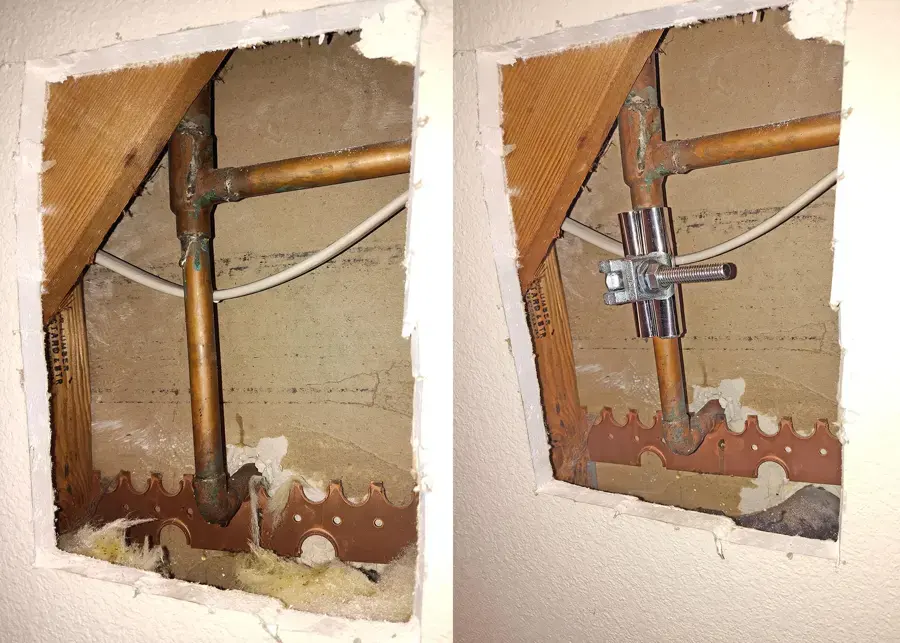
A pipe that bursts inside a wall rarely announces itself with a spray. More often it shows up as a bubble in the paint, a warm patch on the floor or the sound of running water when nothing is on. In a house with a long history of use, the leak can run for some time before anyone sees it.
Key takeaways
- Shut off the main water supply first, then deal with the power in wet areas.
- Sweetwater Authority provides water service in Bonita, and the main shutoff is the first valve to close.
- Many Bonita homes are tract homes from the 1960s, 1970s and 1980s, and the water that escapes from a wall often spreads under the floor and into baseboards.
- Wet drywall and insulation are opened so the cavity can be dried, instead of leaving moisture trapped behind paint.
- Moisture readings, not appearance, decide when the drying equipment stops.
Signs a pipe has failed inside a wall
A leak behind drywall is easy to miss. The first signs are quiet, and each one points to water that is moving where nobody can see it.
- Paint that bubbles, peels or darkens in a spot that was fine last week.
- A baseboard that swells or separates from the wall.
- A floor that feels cool, soft or damp near an outside wall or a bathroom.
- A water meter that keeps moving when every fixture is off.
- A hiss or trickle sound behind a wall in a quiet room.
What to do at the shutoff
Stopping the water is the step that limits damage. Every extra bit of flow adds more water to the wall, the floor and the room below.
Close the main supply
Locate the main shutoff for the house, which is often near the water meter or where the supply enters the building. Turn it fully off, then open a faucet at the lowest point to drain remaining pressure.
Watch the electrical side
If water has reached outlets, switches or a ceiling light fixture, turn off power to that part of the house at the panel. Do this only if the panel is dry and the route to it is not wet.
Document before moving things
Take photos of the wall, the floor and the wet belongings. Move small items to a dry room, but leave soaked carpet and furniture for the extraction crew.
Why Bonita homes can hide a slow leak
Large parts of Bonita are housing tracts built in the 1960s, 1970s and 1980s. Many sit on larger lots, and homes rise into hills on both sides of the Sweetwater River valley.
With about 2.83 persons per household and 4,433 households counted by the Census, the family routines of laundry, showers and a dishwasher mean a hidden leak can run alongside normal use and go unnoticed.
Sweetwater Authority is a publicly owned agency formed in 1977 that serves about 200,000 people. Its water comes from deep wells, Sweetwater River runoff stored in reservoirs, San Diego Formation wells and imported water, and Bonita Valley Reservoir is the largest treated water tank in the system.
A burst pipe inside a house is a plumbing job, not a utility job, so the plumber and the restoration team handle it while the utility only supplies the water. The Bonita water damage pros work with homeowners on the second part.
- Homes rise into the hills on both sides of the river valley, so a leak in an upper room can reach the floor or ceiling below.
- A leak that runs alongside normal laundry and shower use is easy to mistake for ordinary dampness.
- A hidden leak in a family home often affects several rooms before the first stain appears.
What the extraction and drying team does
The first job is extraction. Standing water is pulled from floors and carpet so it stops spreading into adjacent rooms.
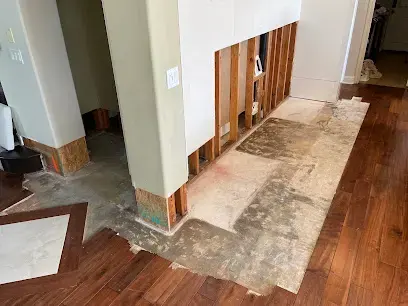
Then the wall is opened. The team removes baseboards and cuts the drywall back past the wet area so the pipe, the stud bays and the insulation can be seen and measured.
The team opens no more than the readings call for. Drywall is cut in straight, clean sections so patching is simple later, and baseboards are set aside so they can go back on when the wall is dry.
Cabinets and flooring that share the wall are checked as well. A wall behind cabinets can trap water behind the toe kicks, and wood or laminate flooring can swell at the seams while the surface still looks normal.
- Water extraction from carpet, pad and hard floors
- Removal of baseboards and wet drywall sections
- Removal of wet insulation that cannot be dried
- Placement of air movers and an LGR dehumidifier for the cavity
- Daily moisture readings on studs, plates and floor
How long the equipment stays
There is no fixed number of days. Equipment stays until moisture readings on framing, subfloor and drywall are back to normal for the home.
A pipe burst caught early may only affect a single wall. A long hidden leak can reach cabinets, flooring across rooms and the ceiling below, and that is when the drying plan grows.
- Readings on the wet wall are compared with an unaffected wall of the same material.
- Equipment is moved or removed as each area reaches normal.
- Final readings are recorded before any drywall goes back up.
Plumbing repair and restoration are separate jobs
A plumber repairs or replaces the failed pipe, and the restoration team dries and rebuilds what water touched. The two jobs overlap in time, because the wall often cannot be closed until the plumber has finished and the readings are dry.
Both parts are documented. Photos of the burst section, the opened wall and the moisture log help support a claim, and coverage depends on the policy.
In a household of about 2.83 people, a repair overlaps with school, work and meals. A clear schedule of when equipment will run and when the wall can be closed helps the household plan around the work.
- Ask the plumber to leave the wall open until the drying team has taken final readings.
- Keep the failed pipe section if possible, since an adjuster may ask to see it.
- Check that cabinets and floors above and below the wall are tested for moisture.
Reducing the risk of a repeat
A burst pipe is not always preventable, but regular checks catch problems sooner. Looking at the water meter once a month and walking the house for stains and soft spots is a small habit that catches problems sooner.
For more detail on the process, see the pages on burst and pinhole pipe leaks in Bonita and structural drying.
Questions
What is the first thing to do after a pipe bursts in a wall?
Turn off the main water supply, then open a faucet at the lowest point to relieve pressure. After that, turn off power to wet areas only if the panel is dry and reachable.
Who provides water service in Bonita?
Sweetwater Authority provides water service in National City, Bonita and the western and central parts of Chula Vista.
Can wet drywall be saved after a pipe burst?
Sometimes, if it is caught early and readings show the drywall dries completely. Wet insulation is usually removed, and drywall that stays soft or stained is cut out.
How is a wall confirmed dry after a pipe burst?
A moisture meter is used on the drywall, studs and floor, and readings are compared with a dry reference. Equipment stays until those numbers match the dry reference.
Does the restoration team repair the pipe?
No. A plumber repairs or replaces the pipe. The water extraction and drying team handles the water the pipe released.